Quick Links
Browse By Peptide
- 5-Amino-1MQ
- Ac Sdkp Goralatide
- Ace 031
- Acetic Acid
- Acetyl Hexapeptide 3 Argireline
- Adamax
- Adipotide
- Ahk Cu
- Aicar
- Akg
- Alprostadil
- Aod 9604
- Ara 290
- Bacteriostatic Water
- Bam 15
- Bpc 157
- Bpc 157 Tb 500
- Bronchogen
- Ca Akg
- Cagrilintide
- Cardiogen
- Cartalax
- Cerebrolysin
- Chonluten
- Cjc 1295 Dac
- Cjc 1295 No Dac
- Cjc 1295 No Dac Ipamorelin
- Cortagen
- Cortagen Peptide Research Guide
- Crystagen
- Dermorphin
- Dihexa
- Dsip
- Epithalon
- Follistatin 344
- Foxo4 Dri
- Ghk Cu
- Ghrp 2
- Ghrp 6
- Glow
- Glutathione
- Gonadorelin
- Gotratix A18
- Hexarelin
- Hgh Fragment 176 191
- Humanin
- Hyaluronic Acid
- Igf 1 Des
- Igf 1 Lr3
- Ipamorelin
- Kisspeptin 10
- Klow
- Kpv
- Liraglutide
- Ll37
- Matrixyl 3000 Complex
- Mazdutide
- Melanotan I
- Melanotan Ii
- Methylene Blue
- Mgf
- Mk 677 Ibutamoren
- Mots C
- Na Epitalon Amidate
- Na Selank
- Na Semax
- Nad
- Nad Plus
- Nmn
- Nmnh
- Nonapeptide 1
- Ovagen
- Oxytocin
- Pal Ghk Peptide
- Pancragen
- Pe 22 28
- Peg Mgf
- Pentapeptide 18 Leuphasyl
- Pinealon
- Pnc 27
- Prostamax
- Pt 141
- Ptd Dbm
- Reconstitution Solution
- Resveratrol
- Retatrutide
- Retatrutide Cagrilintide
- Selank
- Semaglutide
- Semaglutide Cagrilintide
- Semax
- Sermorelin
- Servodutide
- Slu Pp 332
- Slu Pp 332 Bam15
- Snap 8
- Ss 31
- Survodutide
- Syn Ake
- Syn Coll Peptide
- Tb 500
- Tb 500 Frag
- Teriparatide
- Tesamorelin
- Tesamorelin Ipamorelin
- Tesamorelinipamorelin
- Tesofensene
- Tesofensine
- Testagen
- Thymalin
- Thymosin Alpha
- Thymosin Beta 4
- Tirzepatide
- Triptorelin
- Vesugen
- Vilon
- Vip
- Vip Peptide
Browse By Application
- Addiction
- Alzheimers
- Anti Aging
- Antimicrobial
- Anxiety
- Appetite
- Autoimmune Disorders
- Bladder Urinary Health
- Body Composition
- Bone Joint Health
- Cancer
- Cardiovascular Health
- Cellular Energy
- Circadian Health
- Cognitive Enhancement
- Cosmetic
- Crohns Disease
- Depression
- Diabetes
- Ear Hearing Health
- Endocrine Health
- Epigenetics
- Eye Health
- Fat Oxidation
- Fertility
- Glp
- Growth Hormone Optimization
- Gut Health
- Hair Scalp Health
- Hormonal Balance
- Immune System Support
- Immunomodulation
- Infection
- Inflammation
- Inflammatory Bowel Disease
- Injury Recovery
- Irritable Bowel Syndrome
- Kidney Health
- Leaky Gut
- Libido
- Liver Health
- Longevity
- Menopause
- Mens Health
- Mental Health
- Metabolic Health
- Mitochondrial Health
- Muscle Growth
- Neural Regeneration
- Neurodegenerative Diseases
- Neuroprotection
- Oncology
- Oral Dental Health
- Osteoporosis
- Pain Management
- Parkinsons
- Perimenopause
- Polycystic Ovary Syndrome
- Post Traumatic Stress Disorder
- Respiratory Health
- Sexual Health
- Skin
- Sleep
- Spinal Cord Injury
- Sports Performance
- Telomere Biology
- Thyroid
- Tissue Repair
- Weight Loss
- Womens Health
- Wound Healing
When a Vendor's Manufacturing Process Page Is Someone Else's: A Documented Case
AI Summary
Cenexa Labs published a 12-step "Cenexa Pure" manufacturing process page in October 2025. In January 2026, a near-identical 12-step page appeared on the Licensed Peptides website under Licensed Peptides branding. The copy reproduces the original's layout, illustrations and wording, and it carries several spelling errors the original does not have. It also reproduces a badge claiming to be the only US research peptide manufacturer, a claim two companies cannot both hold. The practical lesson for buyers is that a polished peptide vendor manufacturing process page is not, by itself, evidence of a real process.Every peptide buyer gets told the same thing: do your own research, check the vendor, look at how they make the product. So you go and look. You find a polished page titled "our manufacturing process," twelve steps, cleanroom photos, purity figures, a badge or two. It looks like exactly the kind of thing you were told to check for. In June, a public post from one supplier raised an uncomfortable question about pages like that, and the evidence behind it is worth walking through carefully, because it changes what that page is actually worth as a signal.
What Actually Happened, and How This Surfaced
On June 7, Cenexa Labs published a post on its public Facebook page. The tone was notably restrained. It said that CenexaPure is the manufacturing process it uses and documents at cenexalabs.com/cenexa-pure-process/, that the page was published in October 2025 after the company hired a designer to build it from its own source material, and that in January 2026 a version of it appeared at licensedpeptides.com/manufacturing-process/ under Licensed Peptides branding.
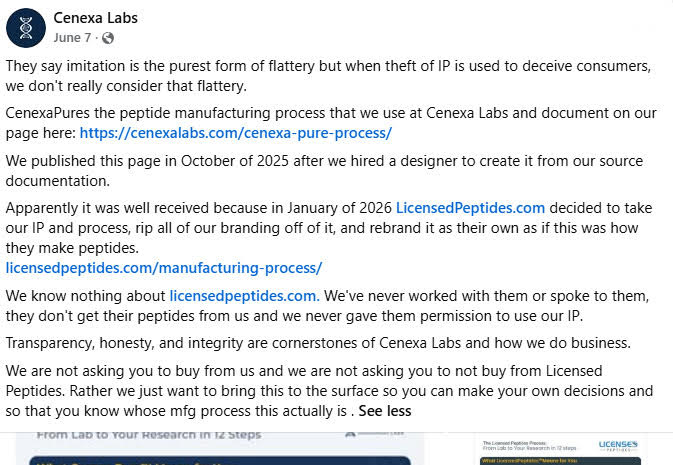
Cenexa's own words for this were "theft of IP." That is Cenexa's characterisation, not ours, and we are repeating it as their statement rather than adopting it as a finding. What is worth noting is how the post ends. Cenexa explicitly does not ask anyone to buy from them, and explicitly does not ask anyone to avoid Licensed Peptides. It says it wants to "bring this to the surface so you can make your own decisions and so that you know whose mfg process this actually is."
MyPeptidePal has no relationship with either company. We are not a party to this, we do not sell peptides, and we are not telling you where to shop. We went and looked at the two pages because the underlying question is one that affects every reader here.
Where this guide comes from
Most peptide guides are written from whatever the author could find on the internet. This one is built on something different. The MyPeptidePal Knowledge Base aggregates every published clinical study, peer-reviewed trial, in vitro finding, and documented human use case on peptides into a single continuously updated system. What makes it unique is the layer on top of the published literature: MyPeptidePal currently tracks over 10,000 active user protocols every day, with more than 900 new protocols created and refined daily by real users logging their actual results.
That means the dosing ranges, outcome timelines, and safety notes in this guide are not only sourced from published literature — they are cross-referenced against real-world protocol data from thousands of people actively using these compounds. When the research and the real-world data agree, we say so. When they diverge, we note it. The goal is the clearest, most complete picture of what the evidence actually shows.
The Two Peptide Vendor Manufacturing Process Pages, Side by Side
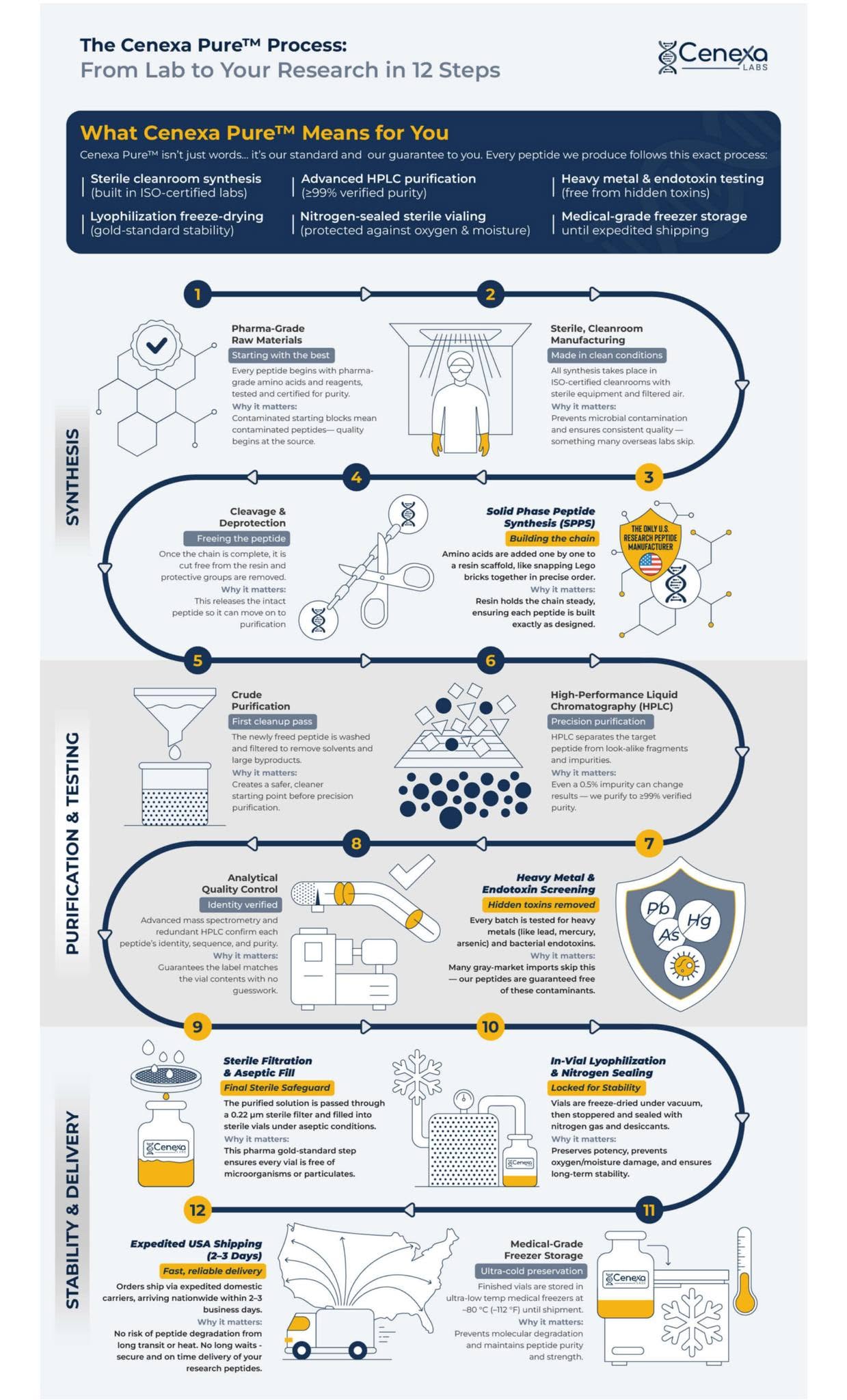
Here is the Cenexa version, published October 2025.
And here is the Licensed Peptides version, which appeared in January 2026.
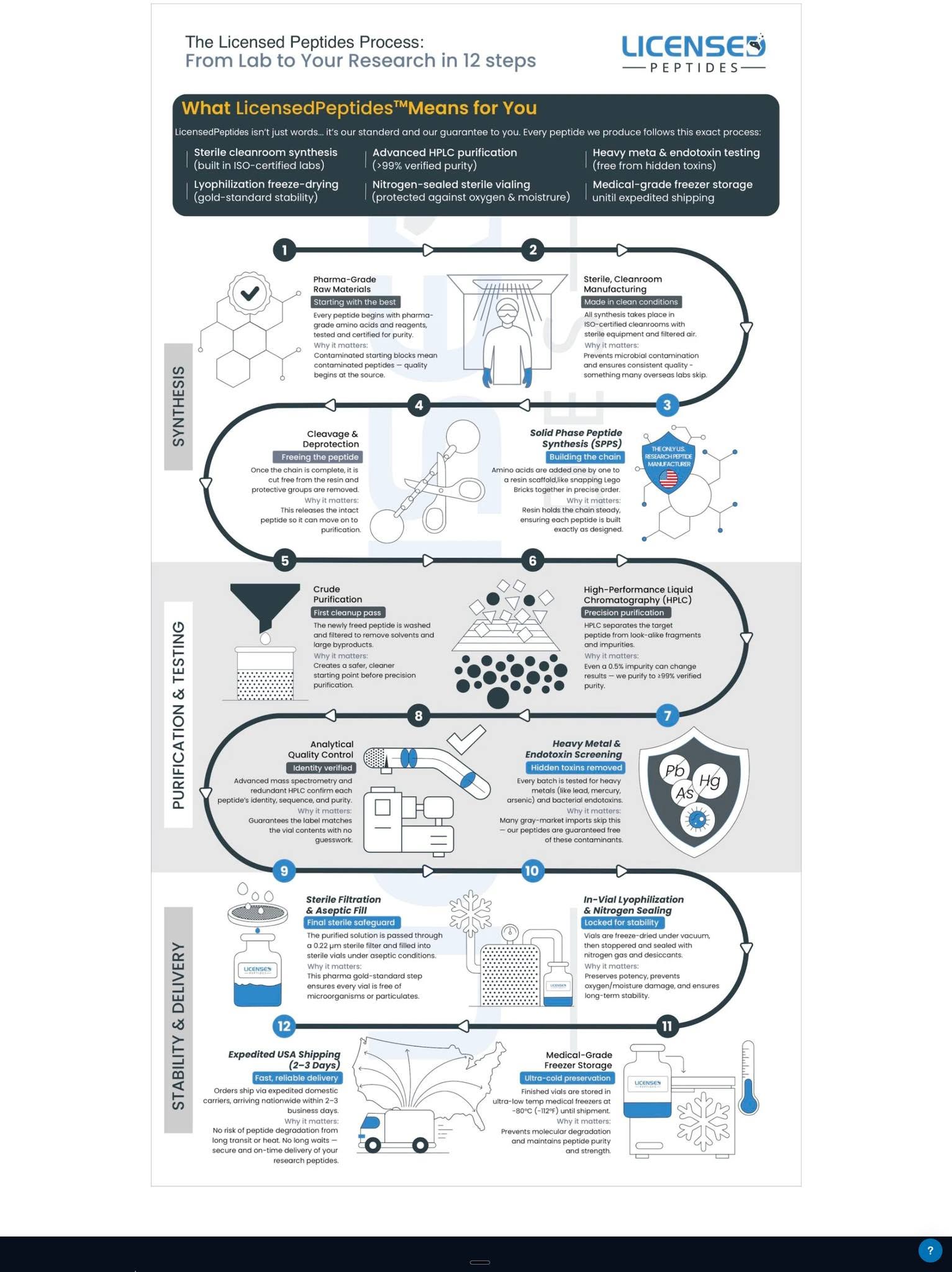
Look at them rather than take our word for it. Both are titled "From Lab to Your Research in 12 Steps." Both open with a dark header box in the same position, using the same construction: "What Cenexa Pure Means for You" against "What LicensedPeptides Means for You." Both carry the same six bullets in the same order, with the same wording: sterile cleanroom synthesis, advanced HPLC purification (HPLC is high-performance liquid chromatography, the separation step used to isolate a peptide from impurities), heavy metal and endotoxin testing, lyophilization freeze-drying (lyophilization is the freeze-drying that turns the peptide into a stable powder), nitrogen-sealed sterile vialing, and medical-grade freezer storage.
Below that, both run the same serpentine flow of twelve numbered steps, grouped into the same three bands: Synthesis, Purification and Testing, and Stability and Delivery. The step titles are the same, in the same order. The illustrations sit in the same positions. The explanatory copy under each step, including the bolded "Why it matters" notes, is reproduced word for word.
Three Details That Separate Copying From Coincidence
Similar pages are not automatically suspicious. Peptide synthesis genuinely does follow a broadly standard sequence, and two honest companies could describe it in similar terms. So similarity alone proves nothing. Three specific details do.

The spelling errors exist only in the copy
The Licensed Peptides version says "it's our standerd." It says "Heavy meta and endotoxin testing," missing the l in metal. It says "protected against oxygen and moistrure." It says "unitil expedited shipping." It says a resin "scaffold,like snapping Lego Bricks," with the space missing after the comma.
The Cenexa original contains none of these. Every one of those sentences is spelled correctly in the version published four months earlier.
Two teams writing independently do not produce the same sentences. They certainly do not produce the same sentences with fresh misspellings introduced. What that pattern looks like is a page that was pushed through an AI tool with an instruction to reproduce it under a new brand, and then published without anyone reading the output.
That is the part worth sitting with, and it matters more than the copying does. Nobody at Licensed Peptides appears to have read the page describing how their own peptides are supposedly made. If you had actually built that twelve-step process, if those were your cleanrooms and your purity thresholds, you would notice that your own website says "Heavy meta." The typos are not just evidence that the page was copied. They are evidence that nobody involved cared what it said.
Both pages claim to be the only US manufacturer
In step three of the original, a gold shield badge reads "THE ONLY U.S. RESEARCH PEPTIDE MANUFACTURER." That badge appears, reproduced, on the Licensed Peptides version too.
Two companies cannot both be the only one. Whatever else is true here, one of those two pages is telling buyers something that is not correct, and it is exactly the sort of claim a buyer leans on when deciding who to trust with a compound they intend to put in their body.
The copy contradicts itself inside a single image
The Licensed Peptides header advertises ">99% verified purity." Step six of the same graphic, a few inches lower, still reads "at least 99% verified purity," matching the original's figure. A purity specification is not a stylistic choice. A company that actually held that specification would not disagree with itself about it inside one image. That is what a copy artifact looks like.
Who Published First
There is a straightforward record of when the original was made. This is a message from the designer Cenexa hired, dated October 7, 2025, delivering the file "12 Step infographic-01.jpg," with the Cenexa infographic visible in the attachment.
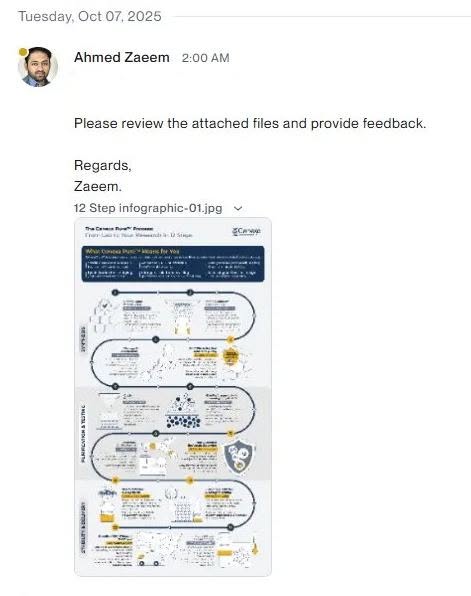
That places the creation of the Cenexa artwork in October 2025, three months before the Licensed Peptides page appeared in January 2026. Cenexa also states it has never worked with Licensed Peptides, never spoken to them, does not supply them, and never gave permission for the material to be used.
We reached no independent conclusion about anyone's intent, and we are not in a position to. What the dates and the images establish is the sequence, and the sequence is not ambiguous.
What This Means When You Check a Peptide Vendor Manufacturing Process
Here is the uncomfortable part, and it is the reason this is worth publishing at all.
"Check the vendor's manufacturing process" is the single most common piece of due-diligence advice in this space. It is what everyone tells beginners to do. And the artifact you are told to check, the process page, turns out to be trivially copyable, and at least once has been copied, badge and typos and all.
So the page you were checking may describe someone else's facility. It may describe no facility. It cannot, on its own, tell you the difference, because a real process page and a copied one look identical to a reader. That is not a reason for paranoia. It is a reason to treat the process page as marketing rather than as evidence, and to weight the things a copycat cannot fake as easily:
- A certificate of analysis for the specific lot you were sent, with a batch number that matches your vial, rather than a generic sample COA hosted on the site.
- Third-party testing you can trace to the lab that performed it, rather than a logo.
- Whether the company will answer a direct, specific question about a specific batch.
- Consistency between what different parts of their own site say. The purity figure that contradicts itself inside a single graphic is a small thing, but it is the kind of small thing that only happens when nobody is checking.
Where Both Companies Stand
We are not endorsing Cenexa Labs and we are not telling you to avoid Licensed Peptides. We have no commercial relationship with either one, and this is not an attempt to move anyone's business in either direction.
At the time of writing, we are not aware of a public response from Licensed Peptides, and we would report one fairly if it comes. There may be an explanation we have not heard. The evidence above is what is publicly visible on two websites and in one public post, and we have shown you all of it rather than summarising it and asking you to trust our summary.
What we will say plainly is that this kind of thing is corrosive. The peptide space already runs on a thin supply of trust. People are asked to evaluate vendors with very little to go on, and then a basic signal like a manufacturing page turns out to be copyable. Every buyer who discovers something like this gets a little more cynical, and the honest operators pay for that cynicism along with everyone else. That is the cost, and it is why it is worth naming rather than quietly ignoring.
Ready to build your {Peptide} protocol?
This guide covers what the evidence shows — the broad ranges, the mechanisms, the research, and the safety picture. What it cannot do is tell you exactly what your protocol should look like, because that depends on your health history, body weight, goals, and what else you are using.
That is what MyPeptidePal does. Tell it about yourself and your goals — it builds a complete, personalized {Peptide} protocol in under 60 seconds. Free to try. No credit card required.
Frequently Asked Questions About This Peptide Vendor Manufacturing Process Dispute
Is Licensed Peptides accused of a crime here?
No, and we are not making that accusation. Cenexa Labs used the phrase "theft of IP" in its own public post, and we have quoted them as saying it. Whether anything unlawful occurred is a legal question that would be decided somewhere other than a peptide website, and we take no position on it. What we have shown you is what is visible on two public pages: the same layout, the same wording, the same badge, and a set of spelling errors that appear in only one of them.
Could the two pages just be similar by coincidence?
Peptide synthesis does follow a broadly standard sequence, so some overlap would be unremarkable. Coincidence does not explain identical sentences reproduced word for word, the same illustrations in the same positions, or the same twelve steps in the same order under the same three section headings. It particularly does not explain misspellings such as "standerd" and "Heavy meta" appearing in one version and not the other.
Why do the typos matter so much?
Because of what they imply about review rather than about copying. A company that genuinely operates a twelve-step manufacturing process would be expected to read the page describing it. Errors like "Heavy meta" and "moistrure" survive only if nobody involved read the text. That is a statement about how much attention the company pays to what it tells customers, which is a fair thing for a buyer to weigh.
Does this mean Licensed Peptides products are unsafe?
Nothing here speaks to product quality, purity or safety, and we are not suggesting otherwise. This is about a page on a website and what it does or does not tell you. A copied process page does not tell you that the products are bad. It tells you that the page is not usable as evidence about how they are made. Those are different claims and it would be unfair to conflate them.
How should I actually verify a peptide vendor manufacturing process?
Ask for a certificate of analysis tied to the specific lot number on the vial you were sent, not a sample COA posted on the site. Check whether the testing lab named on it will confirm the analysis. Ask a specific question and see whether you get a specific answer. None of that is foolproof, but all of it is considerably harder to copy from a competitor than an infographic is.
Why is MyPeptidePal covering a dispute between two vendors?
We do not have a dog in this fight. We are not paid by either company, we do not sell peptides, and whichever way this lands makes no difference to us commercially. What we do have is the same interest as you: we buy peptides too, and we want a peptide space that is more transparent and more honest than the one we currently have.
That is the whole reason this is worth your time. The part that affects our readers is not the dispute itself, it is the discovery that a widely recommended verification step can be defeated by copying and pasting. This is exactly the kind of thing that leaves people with a bad taste about the peptide space and a well-earned lack of trust in it. It is a perfect example of the problem, which is precisely why we are showing it to you rather than writing another general warning about doing your research.
Whatever the explanation turns out to be, the useful takeaway does not depend on it. Somewhere out there is a peptide buyer who did everything they were told to do, found a detailed manufacturing page, decided it looked legitimate, and placed an order on the strength of it. The page may have belonged to a different company entirely. Look at the two images above, decide for yourself what you are seeing, and then go ask your vendor for a batch number.
This guide is for educational and informational purposes only. It is not medical advice, a diagnosis, a treatment recommendation, or a suggestion to use {Peptide Name} or any other compound. The information provided does not replace consultation with a qualified healthcare professional. Always consult a licensed medical provider before starting, stopping, or modifying any peptide protocol or health regimen. Individual results vary. The peptides discussed may be unapproved for human use and may be regulated differently depending on your jurisdiction. Users are responsible for understanding and complying with all applicable laws and regulations in their location.

About MyPeptidePal
About the Author
Marcus Reid is a functional medicine researcher, data analyst, and peptide specialist, and one of the people who built MyPeptidePal. The platform exists in part because of the years he spent immersed in clinical literature, real-world protocols, and the kind of hands-on experimentation that most textbooks skip entirely. He is not a physician and does not pretend to be. What he is, is someone who has done the work to understand how these compounds actually function at a biological level, what the research actually says versus what the forums claim, and how to explain it in a way that makes sense to anyone willing to learn. At MPP, Marcus contributed to building the knowledge base, the protocol frameworks, and the research systems that power the platform. His work covers tissue repair, metabolic health, hormonal optimization, longevity, cognitive function, and cosmetic applications. When the science gets complicated, his job is to make it click.